Planning a Bathroom Remodel in Grand Rapids: The Complete Guide
Plan in dependency order: layout and plumbing first, waterproofing second, finishes last - reversing the order is how projects stall.
Read the Guide
Tile and grout are not waterproof - the membrane behind them is the system, and showers fail at corners, curbs and penetrations, not in the field.
Problem: Tile and grout are not waterproof - the membrane behind them is the system, and showers fail at corners, curbs and penetrations, not in the field.
Solution: Choose one coherent system - sheet or liquid membrane, traditional pan or bonded - and install it as a system, not a collage of products.
When to call: Call when grout darkens permanently, the ceiling below stains, or a shower smells musty after cleaning - water is already behind the tile.
Ask what makes a shower waterproof and most people point at the tile. Tile is the shower's clothing; the waterproofing is its skin - a membrane system behind and beneath the tile that catches the water grout inevitably passes and routes it to the drain. Understanding that distinction explains nearly every shower failure and every durable success. This guide explains how the systems work, where they fail, and what to ask about the shower being built - or diagnosed - in your Grand Rapids home.
The housing stock sets the starting point. Grand Rapids grew in waves: furniture-era mansions and workers' cottages before 1930, streetcar suburbs between the wars, ranch subdivisions in the 1950s-70s, and master-planned growth from the 1990s on. Each era plumbed its bathrooms differently - and each remodel inherits the choices, and the shortcuts, of its era.
Deep summer brings the humidity peak, and bathrooms without working exhaust fans start showing it: peeling paint above the shower, grout that never quite dries, a mirror that stays fogged for an hour. Summer is when ventilation upgrades pay for themselves in the homeowner's eyes - the difference is visible within a week of daily showers.
Glazed tile sheds water from its face, but grout is a porous cement sponge by design, and thinset and backer board behind it are not barriers either - they are water-tolerant materials that pass moisture along. In a daily shower, a meaningful volume of water lives behind the tile line. A waterproofing system assumes this and manages it: a continuous membrane, sealed at seams and corners, sloped at the floor toward a drain designed to receive membrane-level water through its weep paths.
This is why two showers with identical tile have opposite fates. The visible layer is the same; the invisible one was either a system or a hope. When a shower fails - staining grout, mustiness, a ceiling spot below - the autopsy almost never blames the tile.
Traditional construction builds a pan liner over a pre-sloped mortar bed, with cement board walls over a moisture barrier - a system that manages water by collecting it at the liner and weeping it to the drain. Bonded systems move the membrane to directly under the tile: sheet membranes adhered over sloped floors and board walls, or liquid-applied membranes rolled on in measured coats, with the drain bonding to the membrane itself. Both families work; both fail when installed as collages - a membrane here, a competing product there, corners improvised.
The professional question is never which family is fashionable; it is whether the installer works in one system completely - its corners, its seals, its drain - because manufacturers engineer and warrant systems, not mixtures. Ask which system, ask about the corners, and the answer's fluency tells you most of what you need.
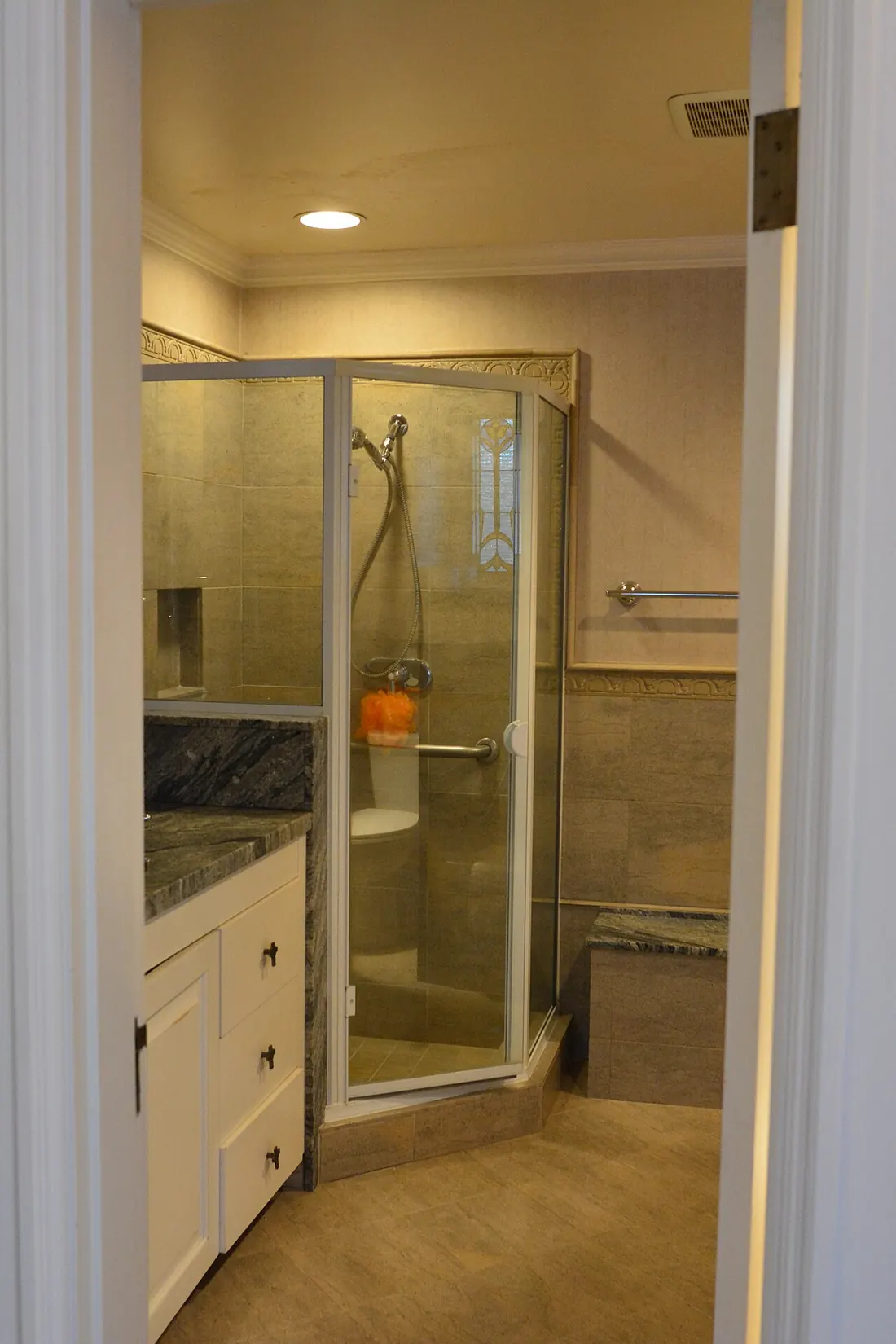
Fields of tile almost never leak; junctions do. Inside and outside corners concentrate movement and workmanship difficulty. Curbs collect penetrations - every screw through a membrane below the flood line is a scheduled leak. Valve and head penetrations need sealing to the membrane, not just escutcheons and optimism. And the glass that mounts through a curb at the end can undo careful work in an afternoon if its fixings pierce the waterproofing at water level.
Flood testing is the honest checkpoint: the pan or floor, plugged and filled before tile, proves itself in a day of standing water. It is the simplest certainty in the entire project, and asking whether it will be done separates system installers from assemblers more reliably than any brochure.
Water announces itself downstream: the ceiling stain below, baseboard swelling beside the shower, grout that darkens and stays dark, caulk that molds from behind, a musty note that cleaning never retires. Each points through the tile to the system - or its absence. The diagnosis matters because surface remedies over a failed membrane are decoration on a leak; the honest repair usually involves opening the shower's wet zones and rebuilding the system, which is why failed showers so often become the remodel itself.
In Grand Rapids' older stock, add one suspect: the mid-century shower built with materials and methods of its era, whose mortar bed and pan have simply completed their service life. Sixty years is not a failure; it is a tenure. The remodel conversation for those rooms starts with respect for the tenure - and a new system underneath new tile.
Walker wraps around Grand Rapids' northwest side, running from the bluffs above the river out along Lake Michigan Drive and Wilson Avenue to farmland edges. Millennium Park - one of the largest urban parks in the region - sits on its Grand River shore, and Allendale-bound traffic passes through on its way to Grand Valley State.
1970s-2000s subdivisions mixed with rural-edge homes and farmhouses, generally on larger lots.
West Grand - the city's West Side - runs along the west bank of the Grand River below the bluff where John Ball Zoo sits. It is one of the city's oldest working neighborhoods, with Polish parish roots, Leonard Street and Stocking Avenue business corridors, and blocks of homes that have housed generations of furniture and factory workers.
Workers' cottages, two-story frame homes and bungalows, mostly 1890s-1940s, with later ranch infill.
Comstock Park is the unincorporated community just north of Grand Rapids where Mill Creek meets the Grand River - home to LMCU Ballpark and the West Michigan Whitecaps, an old mill village core, and the Dwight Lydell Park green along the creek.
Older village homes along Mill Creek plus post-war and newer subdivisions on the surrounding streets.
Under a tiled shower there are exactly two respectable philosophies - a waterproof pan-and-wall system from a single manufacturer, or a traditionally built mortar bed with a liner - and endless disreputable ones in between. The deep content of a shower remodel is choosing a system, respecting its details at corners and penetrations, and testing it before tile makes it permanent.
The drain deserves its paragraph: it is the shower's only moving relationship with the house, and it must connect, seal and stay put while everything around it expands, contracts and gets stood on. Bonding flanges, weep protection, a trap that stays wet and quiet - the drain assembly is where shower longevity is actually decided.
Choose the shower rebuild when the shower is the failed system and the rest of the room can serve - and rebuild it as a system rather than retiling its symptoms. The check that decides: grout that stays dark, a floor that flexes, a ceiling that stains. Any one of the three means the assembly, not the surface, is the project.
That is the service side of this guide's subject. When you are ready, the Shower Remodel page carries the process, the coverage by neighborhood and the number to call.
traditional pan or bonded membrane
One coherent system, named in writing
Corners and penetrations detailed with the system's parts
Membrane-level slope to drain confirmed
Flood test done before tile
Membrane photographed before covering
Waterproofing prices as a system line inside the shower project - membrane, drain, corners and testing - modest beside the tile it protects and the framing it defends. Standalone, it rarely prices alone: diagnosing and rebuilding a failed system is shower reconstruction, and the honest quote says so.
Waterproofing is the least forgiving work in the bathroom and the least visible - the strongest case in this guide series for a proven professional. Vet for system fluency and flood testing, and let price sort the rest.
Treating grout sealer as waterproofing
Mixing products from different systems
Screws through curbs below the water line
Skipping the flood test to save a day
A dry shower is an invisible achievement renewed daily. Build the membrane as a system, test it before the tile, and the prettiest part of the room gets to be the part that was only ever clothing.
Plan in dependency order: layout and plumbing first, waterproofing second, finishes last - reversing the order is how projects stall.
Read the GuidePorcelain is the wet-zone default: denser, less absorbent and frost-proof in ways standard ceramic is not - the distinction matters most on floors and in showers.
Read the GuideNo. Sealer slows grout's absorption; it does not make a system. The membrane behind the tile is the waterproofing - sealer is maintenance on the decoration layer, valuable and entirely different.
Surface products can reduce absorption, but a failed or absent membrane cannot be retrofitted from the front. Honest remediation of a leaking shower opens the wet zones and rebuilds the system - which is why diagnosis comes before any promise.
The shower floor or pan is plugged and filled with water before tiling, then left standing - commonly a day - while the ceiling below is watched. Any leak appears while fixing it is still cheap. Ask for it by name.
Both are proven families. Sheet offers factory-consistent thickness; liquid conforms to awkward geometry. The decisive factor is the installer's fluency in one complete system, including its corners and drain - not the family's marketing.
A properly installed membrane system is a decades-scale installation - it should outlast the tile style above it. Showers failing inside a decade are installation stories, not material lifespans.
One call connects you with a bathroom remodeling professional serving Grand Rapids and the surrounding West Michigan communities - a walkthrough, a clear scope and a written plan before any work begins.
📞 Call Now